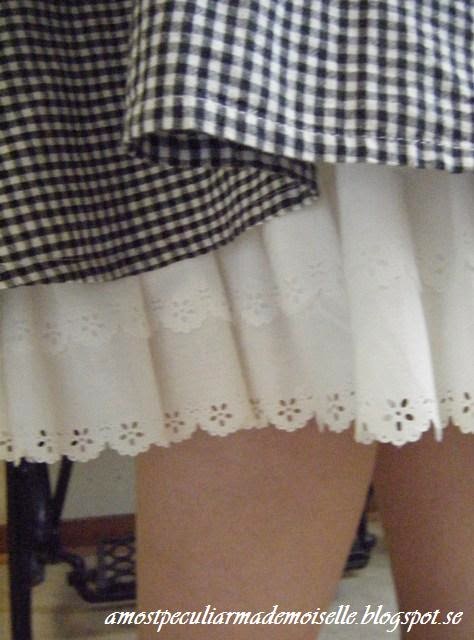
Some years ago I made a hankasärk, a sleeveless shift from the very South of Sweden, to
wear with my folk costume. Now I’m working on a Ca 1810 everyday version of
that folk costume for an event I hope to attend in a few weeks, and need a new hankasärk.
The old one is a bit too loosely woven for my taste, and a smidge tight. In the
beginning of March I made a new one, but I never got round to blogging about it
until now.

I had the cover of
an old mattress, probably used in the early/mid 20th century in a
military or hospital setting. It was made from a very sturdy, handwoven linen,
and though it was stained here and there and had a few unsightly mends, I
thought I could get a hankasärk from it. The densely woven fabric, with nice selvedges, was
too good to pass up.

I had a 1:10 scale pattern,
taken from an extant hankasärk, that I used as a guide when making my first one, so
I knew what the pattern pieces should look like, and I looked at pictures of
extant hankasärkar to see what similarities and variations there were. I
then decided on the measurements for mine, measured on the fabric, and cut to a
thread. All the pieces are rectangles of various sizes: one for the front and
back (there are no shoulder seams), one in each side, two narrow ones to form
the waistband, and four to make up the skirt. In the originals there are
usually three skirt panels, but my fabric was a bit narrower than the ones
originally used, so I chose to use four to get a similar width in the finished
garment.

The bodice part is
made up with back stitches, with all seams neatly felled to one side. I then
hemmed the sides, that would be arm openings. After doing this I discovered
that I’d sewn one side inside out – oops. Several friends advised me to let it
be; similar mistakes are seen in extant shifts. I pondered what to do while
working on the skirt part, and then unpicked the armhole hem that was inside
out, and stitched it again, to the right side this time. I left the side seams
be though: they were discreet enough not to bug me. All seams and hems were
made as narrow as the fabric would allow.

The skirt panels
had neat selvedges, so to make maximum use of the width, I whip stitched them
together. This made almost completely flat seams when pressed. As I have
upcycled the material, there are holes from the previous seams,
but hopefully they’ll mostly go away in the wash.

The skirt is
attached to the waistband with stroked gathers. They turned out a bit less tight
than I’d wanted (I might be bit wider than the original wearers, or I didn't do the gathers fine enough), but it’s acceptable.

The waistband and bodice (with all edges, including the bottom, hemmed) were then joined by whip stitching.

I managed to avoid
the worst stains when cutting out the hankasärk, but there are still a
few fainter ones. I decided not to let them bother me though. There were also
the few holes that had been mended by machine. Though reasonably well done,
machine mending on a shift I intend to be from well before a proper sewing machine
was invented just wouldn’t do. I unpicked the mending, and redid it by mending
a larger hole with a patch, and two smaller ones by sewing/weaving linen
thread over them. These flaws make the shift look well worn and cared for, something I don’t
mind at all. There’s no fun in looking all sparkling new, like you wore a fancy costume instead of proper clothes, especially not in a lower class living
history setting.

For all sewing I
used linen thread that I strengthened with bees wax. For the monogram – common in
large households in a time were all linens looked more or less the same – I used cotton embroidery floss. Most people in early 19th century Sweden used patronymic
surnames, so the first letter stood for the person’s first name, the second for
their father’s first name, and the third for son/daughter. It’s a practice
still used in folk costumes. You can also see the seam that ended up wrong side out.

This will be my
first entry in this years’ Historical Sew Monthly. It could have fit under
February’s 'Re-Make, Re-Use, Re-Fashion', but obviously it
was too late for that, so instead I’ll put it under April’s
’Circles, Squares and Rectangles’.
The Challenge: #4 Circles, Squares and Rectangles.
Material: Handwoven linen.
Pattern: Based off of period examples.
Year: Ca 1800-1850.
Notions: Linen thread, bee's wax, cotton floss.
How historically accurate is it? Pretty close in both material,construction and sewing.
Hours to complete: No idea.
First worn: Hopefully at an event in a few weeks.
Total cost: About 50 SEK (5,25 Euro, £4,49, $5,6), not counting the work.
The Challenge: #4 Circles, Squares and Rectangles.
Material: Handwoven linen.
Pattern: Based off of period examples.
Year: Ca 1800-1850.
Notions: Linen thread, bee's wax, cotton floss.
How historically accurate is it? Pretty close in both material,construction and sewing.
Hours to complete: No idea.
First worn: Hopefully at an event in a few weeks.
Total cost: About 50 SEK (5,25 Euro, £4,49, $5,6), not counting the work.