Tuesday, 18 December 2012

Swedish Common Women’s Dress in the Mid 1800’s

I plan to (sometime) make a mid 1800’s outfit suitable for a wife of a man with a lower, but tolerably comfortable income, like a craftsman, clerk or lower civil servant. I prefer representing that social class, as high fashion is not my thing in real life; and though I can appreciate the beauty and workmanship going into fine period clothes (I love seeing the amazing outfits some of you talented ladies create), it’s just not me. I’m a simple woman of simple origins, and the sort of pretentions adopted by people of wealth and fashion does not agree with me. Besides, my little boy will be in tow to most events I ever go to, and that would seldom have been the case for a woman of the world in the past: she’d have had a nursery maid taking care of little Master B, while she herself was enjoying herself. I disapprove.

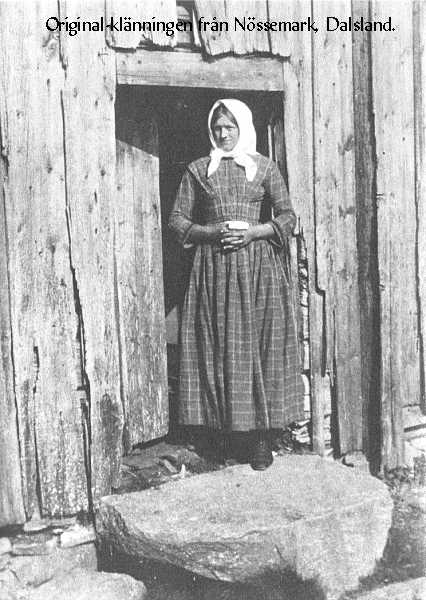
So anyway, the dress. In Sweden, and the rest of the world in the mid 1800’s, there were, not surprisingly, most often a difference in material, construction and accessories between the dresses of common women, and those truly able to follow what fashion dictated. I have stumbled on some difficulties in my research – the clothing of country women is tolerably well documented, but I can’t find much in the way of primary sources for the class I’m looking for. Some things may however apply to common women in both country and town, so I’ll write about what I’ve found. All pictures of dresses are from Digitalt Museum, and you can follow the links back to each dress. There are so many pretty dresses that I like, so I could hardly choose, and had to post several of them.

Material: From what I understand, in some countries it was common practice for women of all classes to buy ready made fabric at this time. 


NM.0092010 Wool jaquard, ca. 1850's.

Here in Sweden, while ready made silks, fine wools and cotton prints were certainly available, many women still spun and/or wove their own cloth.


A woman weaving in the living room, her son pausing in his play to have a snack, and the lodger Josabeth Sjöberg (who did the painting – I’ll be writing a post about her later) copying music. This is in Stockholm, so even in the capital women where weaving at home, though this, 1838, is a little earlier than what I’m aiming for.

Women in service (at least in the country) mostly received pay in the form of food, lodging and wool/cotton/flax which they themselves had to spin, weave and sew into clothes. Home woven wools, cotton warps with wool (or even silk) wefts, and cottons can all be seen in extant dresses. Blends of materials in the weft can also be seen; wool, silk, cotton and linen may well be used in the same dress. 


NM. 0105032 Cotton warp, wool and cotton weft, ca. 1855-65.

In wool dresses, solids are not uncommon. Many black dresses survive (though I didn't like any of them well enough to post), as black was common for best dresses, including wedding dresses for women of smaller incomes.

 NM.0238771 Cotton warp, wool weft, ca.1865-75.

If the warp is cotton, it's often in a different colour from the weft. 

 NM.0107418 Blue cotton warp, reddish-purple wool weft, ca. 1850-65.

Checks and plaids are very common both in wool, cotton/wool and cotton dresses. 


 NM.0232473 Home woven cotton, ca. 1850's.


NM.0162998 Home woven cotton, ca. 1840-60.

NM. 0148437 Cotton warp, wool weft, ca. 1850's.

Sometimes a home made fabric could be handed in to be printed.

NM.0182337 Home woven, brown cotton warp, black wool weft, printed, ca. 1840-55.

It’s likely that a woman may have owned dresses made from both ready made and home woven fabric.

NM.0111733 Cotton print, ca. 1850-70.  

Construction Details: Most dresses are entirely hand sewn, but a few have some machine stitching. Like the fashionable dresses, the common women’s often have
- lined bodices and sleeves
- piped seams in the bodice
- dropped shoulders
- shoulder seams pushed back
- skirts pleated at the front and sides, but gauged, or more tightly pleated in the back
- faced hems 
- darts in the bodice front (though most of the time only two)
- sometimes sleeves cut on the bias
- sleeves are cut with one or two seams, usually with one or two small tucks at the elbow. Some are rather tight, others wider and sewn to a cuff, or left loose and slightly flaring at the wrist. In the 60’s, coat sleeves begin to appear.

But while fashionable dresses usually had princess seams in the bodice back, the common women's dresses have
- just two back pieces in most cases
- front closure (even in the 1840’s, when fashion called for back closure – very practical), with hooks and eyes, often lacquered black.

NM.0189270 Hand woven, warp in wool and cotton, weft in wool, cotton and linen, probably 1860's.

- the opening continuing down into the skirt (no dogleg closure), but as an apron would have been worn by at least the country women, it did not show
- boning made of cane, if any was used. Some dresses are so heavily boned it's doubtful any other support was used.
- an often slightly wider neckline than is common in at least the 50’s and 60’s

One can also see that some details may be present long after they’ve gone out of fashion, like fan front dresses in the 70’s (like in this picture).

I really love these dresses, and can’t wait to make one for myself! Well, actually I’ll have to wait, as I have neither the material, the money, nor the time to make one now. Sigh. Well, it does give me time for more research. Underwear and accessories worn by these women is of course also interesting, and essential, but I will post on that separately, as it’s in these details you can truly differ between a working class or lower middle class Swedish woman and, say, an American one. It’s also where I’ve found it most difficult to find information.

Edit; the post on Swedish common women's mid 19ch century underwear can be found here, and the one on accessories here.

Friday, 14 December 2012

Mystery Project


For a couple of weeks we’ve had snow here (it’s snowing again tonight), and though I know the snow has caused a lot of trouble in the traffic, I’m so pleased. I love the look of snow, and how it adds a little brightness to the dark afternoons and evenings of our northern winters. By four in the afternoon it’s pitch dark here, and where my sister and her family lives, much further north, it hardly gets light at all at this time of year. Hopefully the snow will stay over Christmas. The snow does hinder one to get around with the pram though, so we’ve been home a bit more than usual lately. 


My baby just had his first birthday. How fast this year has passed! It feels like we’ve had him in our family forever. His first teeth finally poked through (so far I’ve not been bitten when nursing…), and he learned to walk for real a week before his birthday. He doesn’t really speak yet, but wants to know what everything is called. I think he’s building up quite a vocabulary for when he will.

I’ve not been idle since last I posted, but I don’t really have anything fun to show for it yet.
I began working on a dress from old curtains in November, but was then interrupted by another, more intriguing, project. My 15 year old sister is going to a Church youth conference after New Years, and one of the dances is themed “Disney”. She asked me for help, and as I was pining away from the lack of fun costumes to make, it really came as a blessing.

I won’t tell what costume I’m making just yet, but will give you a sneak peak. 


 Feel free to guess though ;)

Friday, 16 November 2012

Cording Stays

A short post to show a couple of pictures of the cording I’m doing on my regency stays – just because I’m so pleased with how it’s turning out so far.


It’s the front left side shown, but the right one is as far done, as I work them both at the same time.


Cording is fun!

Thursday, 8 November 2012

Hearts For the Christmas Tree

Last week we had visits from both our families, and though very nice to see them, it left me rather tired (I’m one of those people who is drained on energy when surrounded by people, and gains energy when being alone, or with my closest family) and uninspired to work on my coat. Instead I felt like making felt hearts for the Christmas tree (pretty and unbreakable if pulled down by small hands), but thought the felt at the hobby suppliers’ was too expensive. 


I do however have wool scraps left from making my red kirtle, so I dug them out, and looked for pieces big enough for my hearts.


The hearts are hand stitched, wrong side out. They are then turned, lightly padded and trimmed with smaller hearts of scrap linen, attached with blanket stitch in green, to match the ribbon hanger. A brass button and some quilting in the same colour as the linen complete the look. I had eight buttons, so I made eight hearts. I would like to make more, decorated in a different way, but for now, I’m happy to have completed these. A completed project is not an every day occurrence for me, not even before having a baby. (Speaking of which; I did start and finish (!) a cushion cover today, also for Christmas. More are planned, so I’ll post about that later.) 

I would also have liked to have made these more decorated, with embroidery and so on, but knowing myself, I thought I’d better keep it simple, and actually see them finished this year. 

Wednesday, 31 October 2012

Not Much New

At least not much new to post about. I’m currently working on my new winter coat, in delicious wine red wool. The picture does not do it justice at all. If all goes well it’ll be beautiful. Not sure if I’ll get it finished this winter, though….


I’m also sewing on my long neglected regency stays, when working on the coat isn’t doable for some reason. I have the bust gussets sewn in, and am working on all the cording on the front piece. 


I try to get the last boxes unpacked, and enjoy the candles shining in the evening darkness. I love autumn.


Little B is walking around, pushing a chair for support. He understands most of what we say now, and find enjoyment in the praise he gets when doing what we ask him to. He’s a delightful, sweet, clever, loving little person, smothering us with very wet kisses. I’m so happy to be his Mum, and lucky to be a stay at home Mum.


I’m thrilled that Sewing with Babies is being shared! For the moment I can get a few stitches done every now and then if I do my sewing standing up (if I sit down I must be doing something fun, and B will want to be part of it, which is not always possible), or having him in my lap, and explaining what I’m doing (“the needle goes down through the fabric, then up, and SWISH goes the thread! Down, up, SWISH!”).   

Tobias and I are watching the Wartime Farm series, and it’s as delightful as Victorian Farm and Edwardian Farm was. I want to make a down quilt just like the one Ruth made.


And that’s it really. I hope you all have a pleasant autumn, and hopefully I’ll have something interesting to post about soon.

Tuesday, 2 October 2012

Sewing with Babies - a Blog Award

I know a lot (most?) of you who read my blog, or whose blogs I read, sew. I also know that many have little children. Being able to find time and energy to pursue ones interest in sewing, while caring for the physical and emotional needs of ones children, is not always easy. Lately I’ve found it increasingly difficult, and sometimes frustrating. To encourage all of you out there who, like me, try to find time, but also try not to feel like failures, nor get upset when not succeeding, here is a blog award just for you!


You all know how this usually works:

- Post the text below, describing the award (you are of course welcome to use either of the images in this post on your own blog)

- Link back to the person who gave you the award.

- Describe what you do to make sewing possible, and still have a happy and content baby.

- Pass on the award to three (or more) sewing and blogging mothers of small children.

Recognizing mothers who try (and now and then fail) to find time to create something beautiful and/or useful with needle and thread, between feedings, nappy changes, laundry, nursery rhymes, and baby kisses.


The ones I want to have this award are:

My Mum, Monica, of Creating This and That. Though no longer having any small children (my youngest brother is eight years old) she’s had eight little ones, and always prioritized our needs before her wishes (be they scrapbooking or sewing). No, I do not deny that having a little time to do what you enjoy now and then is a necessity – but it’s all about balancing whose need is the greatest at any given time. She’s my role model when it comes to being a mother, and a woman and wife too.

Sarah Jane of Romantic History, as she’s been my hero in this particular area for years. Even before I had my baby I was amazed at how many beautiful clothes she managed to produce with three small boys running around the house.

Fellow 14th century reenactor Petra of Drömmen om det Medeltida Livet. The Middle Ages means no machine sewing, so she’s got her work cut out for her, with a little baby wanting her attention.

Amy of ADay in 1862. She creates beautiful 1860’s clothes (and shoes) for her little girl.


I hope you will like my little award (a small award from a small blog), and will pass it forward. We all need a pat on the back now and again!

Monday, 1 October 2012

The Return of the Livkjol

Autumn is upon us, and warmer clothing is required. As some of you long time readers might know, I love folk costumes in general, and the ones from my place of birth in particular. Now, I like when you can take an element from period clothing and bring it into ones 21st century wardrobe. I decided to try and see if a livkjol can work today. The livkjol is the main piece of clothing for many country women in Sweden up till the mid 19th century, even longer in some places. It varied a lot in appearance depending on where you lived, always consisting of a bodice with an attached skirt (liv = bodice, kjol = skirt). In the spirit of true local patriotism, I chose to base mine of off the ones close to home. Well, where I lived as a child anyway.


In that part of the country, the west of Skåne (Scania), the bodice and skirt of the livkjol were made from different fabrics, the skirt usually wool, the quality depending on wealth and occasion. The bodices were wool for everyday, and might be for nicer clothes as well, but those who could afford it had bodices in silk, preferably brocade. The bodices on fancier livkjolar were often trimmed with strips of silk in a solid colour. The bodices were closed in front by hooks and eyes, or a chain and buckles in silver or a lesser metal, or simply left open. The skirt was also opened in front, but as most of it was covered by an apron, it didn’t show. All these variations were often dependant on where you lived - a few miles might often make changes in cut and style. You can see a variety of livkjolar from Skåne here.

Now, I wanted a dress that would not be a costume, or a period correct piece of clothing, but a garment that could work today, inspired by a period (and very local) style. Not modern by any means, but not too odd. Silk were out of the question (I have a baby after all), as were too bright colours. I also had to use what was already in my stash. I ended up making a dark brown bodice, trimmed with black strips, and a dark green skirt, all in wool blends.


The bodice is cut in one, and gets some extra shaping from two darts in the front. Darts began coming into use in livkjolar in the mid 19th century, inspired by the current fashion. This picture shows two young girls from the 1870’s in darted livkjolar over knitted sweaters, spedetröjor. Adorable aren’t they? It closes with hooks and eyes. It's is lined with a simple cotton fabric, but back in the day, linen would have been far more common.

The shape of the trim (especially in the back) is typical of some areas in Skåne, and can be seen on the country woman on the left in this picture, Marknad i Lund (Market in Lund) from 1858. It’s made of strips cut on the straight grain, shaped around the curved edges with little stitched down tucks.


The skirt is flat in front (as is often the case in originals), and then pleated with double knife pleats, though I think single ones were more common. I didn’t want a front opening as I won’t wear an apron to cover it, so I made some sort of version of a dogleg closure. While the bodice opens at centre front, the skirt opens under the first pleat to the left, almost invisible. It has a facing in mud coloured cotton at the hem. The skirt is a bit shorter than originals, but I think it works for modern wear.


The greatest deviation I’ll be making is in what I’ll be wearing with the livkjol. It would have been worn over white linen shifts and dark knitted spedetröjor, but I’ll wear it with a bit more modern (mostly store bought) blouses, shirts and sweaters. I did end up having to make the blouse I’m wearing in the pictures, when I remembered that all my pre-pregnancy ones are too small, and will be as long as I nurse. I really tried to sew it using modern techniques, but I have forgotten many of them, and automatically start using period ones…. 


Occupational hazard?