Sunday, 26 May 2013

A Pile of Planned Projects

As our participation in this years living history and re-enactment season draws ever nearer I, as always, find myself heaped with 14th century projects that needs to get done. That’s the problem with having too scattered interests; you don’t make the things you will need until the need is upon you…. As I can’t bear the thought of cheating and machine sew our clothes it takes a bit of time to get it all finished. At the moment I’m working on:

- Tobias’ new buttoned cote. There will be 34 cloth buttons down the front, and a bunch on each forearm. I guess at least 50 in total.


- Shoes for little B. One is stitched, awaiting finishing, the other one not yet begun. They will eventually be front laced, not tied round the ankle as when tried on in the picture.

- A shirt for B. Well, I’ve not really begun it, only ironed the linen, but as I want it done for the next HSF challenge I’ll start it tomorrow.

What I have planned is:

For me
- A shift. Unbleached linen is ordered.
- A veil and wimple – I have semi fine, bleached linen for that.
- A new kirtle. Will be remade from an old grey wool early medieval cote.

For Tobias
- A new pair of hose – brown wool is ordered.
- A new bag hat. We have a lovely thin red wool for that.

For B
- A new cote or two. Wool left over from making Tobias’ clothes will do nicely.
- Possibly a new coif. Fabric for that might be found in my linen scrap box, or the stash.
- Fake cloth diapers, to go over his disposable ones. Again, linen scrap box.
- A period looking toy or two wouldn’t hurt…

Household items
- Pillow cases, from this linen/cotton blend.


- Pilgrims’ satchels. Coarse wool fabric from the wool scrap box (I have several scrap boxes…).


- Linen towels. If large enough linen scraps can be found.

I will likely also make some toddler’s clothes for a friend’s son, in return for nalbound socks for B, as she is much better at nalbinding than I am, and I am the better seamstress. Trading work is a good thing.

Now, not all of the above are equally important. I will have to choose carefully in what order to make things. I also have a paper to write, so as to finally finish my education to be a specialist nurse in paediatrics. Though I’m a stay at home Mum, a university education is always good to have. With all of the above, all I can say is; it's a fine thing that Sunday is a day of rest!

Sunday, 19 May 2013

The Cinderella Dress

I was a little girl when I first saw Rodgers and Hammerstein’s Cinderella from 1965, starring Lesley Ann Warren. I fell in love with it completely and wholeheartedly, and no other version can so far compete with it in my eyes. Certainly, the set is a bit too stylized for my taste, and the costumes are not period – but then, it is a Hollywood interpretation of the Middle Ages from the 60’s, so not much should be expected. Some of the costumes are charming nonetheless. The cast and characters however are just what I think they should be: Cinderella is beautiful, meek and scared of confrontation as she should (if she weren’t she’d not got herself in that serving position to start with); the Prince has a charming personality, and is so sweet when left by the mysterious girl; the King and Queen a fine, properly regal couple; Cinderella’s stepfamily a fun mix of meanness and comical relief. Unfortunately it’s no longer available on DVD. If it’s ever released again I’ll be one of the first to buy it.

As you might guess, little B was  
coming to me when this picture was taken.

I imagine more than one little girl wanted Cinderella’s ball gown, and it is beautiful, though I’d have liked it better with sleeves; it would have fitted in better with the medieval-ish theme. However, being a bit of a Plain Jane I always loved Cinderella’s simple work dress better. The same kind of dresses can be seen on some of the extras. I love how they all have not only blouses, but whole dresses under those sleeveless ones.   


I’ve had an olive-greenish cotton twill fabric in my stash since I was in my late teens, and never could quite decide what to make from it. Recently I decided I wanted a plain Cinderella dress, and this fabric would be perfect for it. 


I did not want to make a reproduction; I just wanted the same feeling, so my dress in constructed in a different way than the movie costume. The bodice is made from four panels, based on my old blue Belle dress, and all fitting is in those four seams, so no darts. I like the clean look it gives. The cotton lining and fashion fabric are treated as one, and all bodice seams are piped, as are the neckline, sleeve holes and the waist seam. 


It closes in the back with hooks and eyes. The bodice is hand sewn, as I am not best friends with my sewing machine, and piping turns out much nicer if I do it by hand. 


It took me a bit of thinking to figure out how to do the skirt. I wanted a ¾ circle skirt, but I couldn’t fit all three panels and still get the length I wanted. After a while I realized I could piece the skirt at the hem in the back. Duh. Had this been a period dress it would have taken no thinking at all to figure that out – with historic clothing piecing is a matter of cause. Excuse the wrinkles: the picture were taken after wearing the dress for a few hours. 


The skirt has pleats at the waist at the front, back and sides, and sewn in smooth in between, and the hem is hand stitched. As with the mid 1800’s common dress, I lost weight between cutting out the bodice and finishing it, so after the dress was done I had to take it in five centimetres, which is about two inches.  I can’t understand that it was so much too large, as I don’t think I’ve lost that much weight, but I don’t think the fabric has stretched either. Now it fits well again; almost too well, just in case I'll loose some more weight.


I really like this dress style, and will very likely make more. I wore the dress for church today, but worn with tricot tops, or coloured, more sturdy blouses it could easily work for everyday. I have a nice denim-look fabric that could work well....

Wednesday, 15 May 2013

Child's Medieval Straw Hat

I didn’t think I’d have anything for the HSF’s ninth challenge, Flora and Fauna, but this morning I realized I did! A very small project, but still.
 

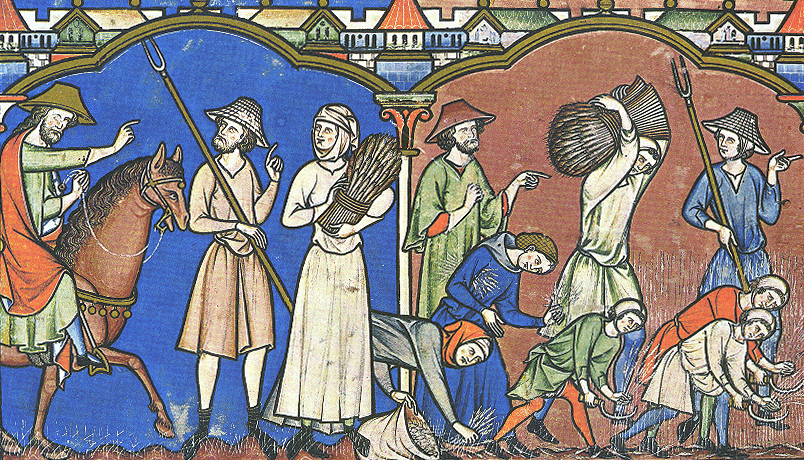
I want medieval straw hats for all of us to wear at sunny events. There are pictures of straw hats beeing used by farmers at harvest through the centuries.

  Maciejowski Bible, French (?) mid 13th century - way too early for us.

 Tacuinum Sanitatis, Italian, c. 1390-1400.

 Great Bible, Britain (?), c. 1405-15.

Last week I found a straw hat in a charity shop that would fit little B. It was your average little girls straw hat, with a round crown, and a brim angling out from it at a ninety degree angle. It was undecorated, but had a petersham band on the inside. Unfortunately I forgot to take a picture of it before refashioning it, which feels really stupid.


I took off the petersham, wet the hat, and when it was pretty much soaked, I put it over a plastic covered wooden bowl I thought had a good shape. I worked the hat a bit to make it shape itself to the bowl, and to make the brim angle down slightly. When I was satisfied with the shape, I let it rest on the bowl for a couple of hours. I then took it off and put it upside down, to encourage the hat to keep the flat crown, and let it dry over night. The crown was still a bit damp in the morning, so I turned it right side up .


After drying it looked just like I’d envisioned, and fit B very well, with room to grow. Little B loves it, which helped a lot when he wore it last weekend to a medieval fair we visited. I added a wool cord to it, to prevent it getting lost.

The Challenge: # 9 Flora and Fauna

Fabric:
Straw.

Pattern:
None. I looked at pictures of medieval straw hats, and tried to imitate them.

Year:
Late 14th century.

Notions:
Twisted wool cord, from my stash.

How historically accurate is it?
Tolerably. The rough shape is seen on medieval straw hats, but it’s sewn with plastic tread. Shudder. I intend to restitch it with linen thread when there’s time, but in the meantime, the plastic only shows if you look really close.

Hours to complete:
Maybe five to ten minutes to cut off the petersham, soak and reshape. One minute to add the cord, that was a left over from another project.

First worn:
For the pictures.

Total cost:
20 SEK ($3; £2; €2,3).

Saturday, 20 April 2013

Viking Conical Cap

For the eighth challenge of the Historical Sew Fortnightly, “By the Sea”, I made a cap for my brother, who does Viking re-enactment. 

 My handsome viking brother.

I had bought an old fur collar years ago, as I intended to make a fur trimmed cap for him, but never got round to making it. Now was the perfect time to finally do it.

Before cutting away the lining and zipper.

I did not want to cut in any of my larger pieces of leftover wools for this, as I intend them for new 14th century clothes for little B, when he’s outgrown the ones he have now. I turned to my scrap bins. I had a fine, dark green wool left over from making my short hose, that just had to be pieced once, and for the lining (the wool was so thin it’d look ridiculously floppy if left unlined) I decided to use up small linen scraps. How many scraps I used in the end I don’t know, more than 15 anyway.

 Most of the piecing done.

The cap is made in the shape of a cone, with a straight linen piece lining the fur sewn to the edge of it.

Simple yet elegant.

It looks a bit like a Father Christmas cap, and when inside out, like a goblin’s cap. I think it has a certain charm that way… 

 Goblin hat?

I made it way back in February, as I had to mail it to my brother, and wanted him to have time to take pictures when wearing it.

The Challenge: #8 By the Sea

Fabric:
Fine tabby woven wool, fur (fox, I think) for trim.

Pattern:
I googled this kind of cap, them measured and cut.

Year:
Viking age, so somewhere between late 8th to mid 11th centuries.

Notions:
Unbleached linen thread.

How historically accurate is it?
It’s hand sewn with waxed linen thread, using historic stitches, but as for the pattern and linen lining – who knows? There are very few extant fabrics from this period, and most are really tiny. In “Viking Clothing”, by Thor Ewing, several types of pointed, conical caps are mentioned, from picture stones, written accounts by Muslim observers, and the Nordic sagas. Wool and silk, gold, silver and sable trim are found in graves, or mentioned. So I’d say it’s plausible. 


Hours to complete: 6-8, but most of that was spent piecing together the linen scraps for the lining.

First worn:
For the pictures, but it is likely to see a lot of use during the summer.

Total cost:
The fabric was left over from old projects, so nothing. The fur cost 20 SEK, I think, which would be $3,16, £2,04 or 2.37.

Tuesday, 16 April 2013

Reenactors - a Documentary

In 2011 a couple of friends of mine, Thomas and Maria (amongst others) pulled of the greatest re-enactment in Sweden to date: the Battle of Wisby 1361-2011. Now a documentary about the project, Reenactors, have been released on YouTube. Do see it - it is in Swedish but subtitled in English.

 Thomas and Maria at the Battle of Wisby 2011, 
picture by Vix.

Sadly I couldn't partake, but instead of looking back with regret, I look forward with the hope of attending Battle of Wisby II this summer. It will be amazing!